
News
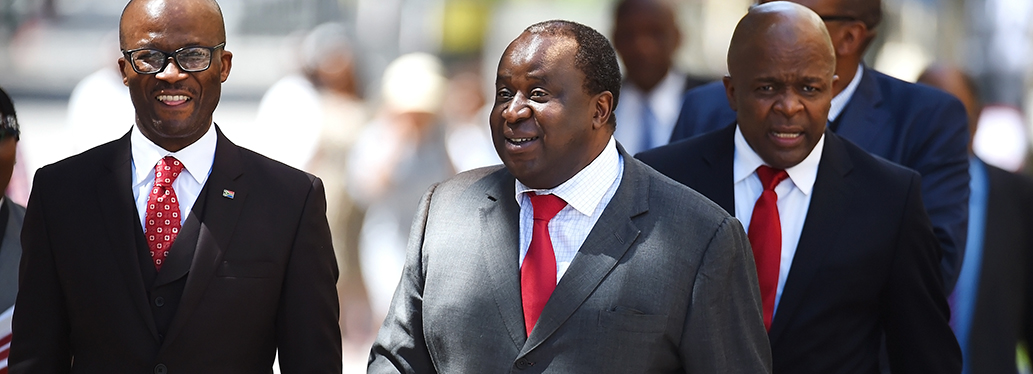
Tito Mboweni: A South African and world leader
Publication Date: 08/11/2024
By Mary Vilakazi –
Tito Mboweni, as the Minister of Labour, the eighth governor of the South African Reserve Bank and as finance minister set in place many of the policies and regulations that shaped our economy and the banking sector, for the better. For his incredible and meaningful contribution, we are deeply grateful.
Following the ANC’s election win in 1994 the South Africa economy had been ravaged by years of political sanctions, negative GDP growth, inflation of more than 10% and interest rates in excess of 20%. Mr Mboweni spent four years as Minister of Labour in President Mandela’s cabinet, where he started shaping his vision for a more inclusive economy. Then in 1998 he was asked to join the SARB and subsequently elected as its 8th governor at the age of only 40.
Mr Mboweni was a true technocrat, and an intellectual with a deep understanding of developmental economics and monetary policy. He was particularly focused on how to create financial stability through delivering on South Africa’s constitutional mandate to protect the Rand and achieve balanced and sustainable economic growth. He was also a brilliant maverick, who was unafraid to try new things that he deeply believed in. This resulted in the SARB adopting the practice of inflation targeting – at the time a relatively new approach to monetary policy implementation. Only 19 other countries had adopted this approach, with its merits still being debated by many economic minds across the globe. However, Mr Mboweni understood the importance of a stable financial system, and the role of its institutions, in the rebuilding of the economy.
Mr Mboweni believed in the role of the Central Bank and the broader financial system to manage inflation. In building the Central Bank’s credibility, he understood that a key aspect would be transparency in the decision making process, and so established the inaugural Monetary Policy Committee in October 1999 and invited the public and the media to participate.
It remains one of South Africa’s greatest advantages in the global financial system that the South African Reserve Bank is considered globally as one of the most credible stewards of responsible monetary policy, and regulators of a sound and stable financial system. The former governor rightly deserves credit for many of the innovations that led to this global respect. But it was his larger-than-life personality, rigorous intellect and ability to engage, explain and cajole, that also strengthened the credibility of the SARB, not only on international stages, but also here at home. He had an innate ability to reach people from different walks of life, with ease.
As finance minister, he would push banks to do more for investment and credit extension; but as a former governor of the SARB, he also understood the dangers of irresponsible lending and the limits of what banks could – or should – do. His management of the social and economic impacts emanating from the COVD pandemic, was exemplary, especially given the pressures on the economy and the fiscus, at the time. He speedily rallied his staff at National Treasury together, to produce an emergency budget that redirected resources to those worse affected.
His “Economic Transformation, Inclusive Growth and Competitiveness” paper and the creation of Operation Vulindlela, are further illustrations of his pragmatism, and ability to prioritise ‘good outcomes’ for the economy. He created space for the private sector to contribute its resources and expertise, to efforts to bolster economic growth. Again, as much as systems and processes were put in place, it was the trust, confidence and high esteem in which he was held that ensured the banks and others put up their hands and partnered with government.
And I have already mentioned, we, as the banking system of South Africa, now reap the benefits of Mr Mboweni’s years of hard work, leadership, and foresight. Our key financial institutions, National Treasury and the Reserve Bank, are considered world class, and our financial system is often lauded as one of the best in world. The independence, courage and competence these institutions continuously display build local and international investor confidence and ensure that South Africa is still an investment destination of choice, even during periods of uncertainty.
Mr Mboweni will be deeply missed, but he leaves us with many lessons that we as business, as leaders, and as South Africans should continue to reflect on today. Let me conclude by saying that, BASA will continue to honour the legacy of Tito Mboweni, beyond today.
- We will honour him as a former Reserve Bank governor, with ongoing efforts to extend financial services to as many South Africans as possible, while remaining responsible stewards of the banks he oversaw.
- We will honour him as a former finance minister, by being active participants, along with government, in the partnerships that have been established to bolster inclusive economic growth in our country.
- And, as individuals and corporate citizens, we will honour him as a visionary South African leader, by steadfastly contributing to transformation and empowerment, to overcome poverty and inequality, and to build the prosperous country he wanted for all South Africans.
Vilakazi is the Chair of the Banking Association South Africa. This address was delivered at the South African Reserve Bank (SARB) and National Treasury memorial service for the former Governor of the SARB, and Minister of Finance, Tito Mboweni.