
News
Empowering One Student Entrepreneur at a Time
Publication Date: 13/06/2025
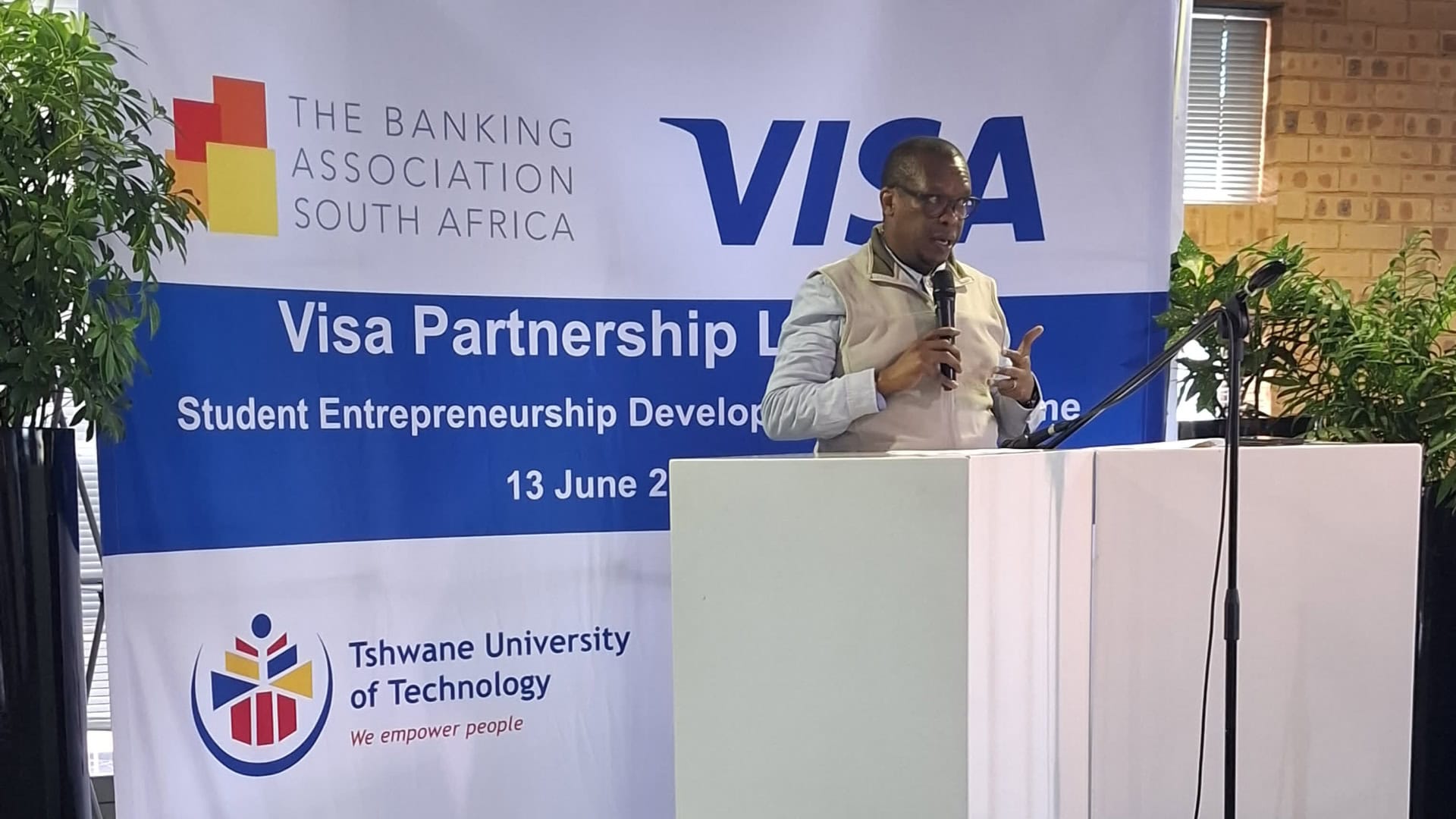
Launch of the Student Entrepreneurship Development Programme
13 June 2025 | Ditsela Place, Hatfield, Pretoria
Dr Thabang Chiloane
Head: Financial Inclusion and Public Policy
BASA
What a delight it is to be in a room buzzing with hope, purpose, and potential. Today is not just about launching another initiative. No. It is about launching lifetimes—businesses, careers, dreams, and maybe even the next Elon Musk or Oprah Winfrey (though this time with a South African accent and a tax number).
We’re gathered here to celebrate the launch of the Student Entrepreneurship Development Programme—a powerful partnership between TUT, BASA, and Visa. This isn’t just another feel-good programme. This is a strategic intervention designed to address one of South Africa’s most persistent challenges: youth unemployment.
Let’s pause for a second. As we sit here, 63% of young South Africans aged 15–24 are unemployed (StatsSA, Q1 2025). That’s not a statistic—it’s a national emergency. But we believe in fighting statistics with stories.
Let me tell you the story of my cousin, young Dimpho. He grew up in the quiet rural village of Ramokgeletsane, in Mpumalanga province, raised by a powerhouse of a woman—his mother—who sold tomatoes and sweetened ice lollies to make ends meet. Dimpho and his sister, barely out of childhood, would hop on their bicycles and deliver goods to customers across their dusty village. This was Dimpho’s first real lesson in entrepreneurship—supply, demand, customer service, and cash flow—all taught under the African sun by a mother with grit and grace.
His mother didn’t have access to finance. She had no collateral, no credit history, and no business mentors. The institutions that were supposed to support people like her didn’t see her. But despite all that, she persisted. She didn’t just sell goods—she built resilience.
Dimpho never forgot those lessons. Today, Dimpho – which means Gifts in Sepedi – is a successful entrepreneur in his own right. He owns businesses in farming, transportation, and retail, and is a true asset to the 500 people he now employs, many of whom are based in the rural provinces of Limpopo and Mpumalanga. He is proof that when you sow entrepreneurial seeds in childhood, they can grow into forests of economic impact. His story is no longer just about survival. It is about scale. And that, ladies and gentlemen, is the power of early entrepreneurial exposure.
This story, and others like it, is why BASA chose to be part of this programme. We know that behind every entrepreneurial success is a moment of support—an intervention, a mentor, a spark. BASA is here to be that spark. As the banking sector’s voice on matters of financial inclusion and public policy, we are committed to ensuring that students like Dimpho are not left behind simply because they lack financial knowledge, access, or networks.
We are here because we believe that the sustainability of South Africa’s economy depends not only on big corporations, but on the small businesses still to be born in classrooms, townships, and villages. We are participating in creating pathways for students to enter the economy not as job seekers, but as job creators. And we want to do this in a way that is intentional, practical, and inclusive.
Here’s what we at BASA are offering:
- Financial literacy training tailored to empower students with real-world money skills—budgeting, saving, managing debt, and understanding the financial system.
- Entrepreneurship Work-Integrated Learning, facilitated in collaboration with our partners, to give students a taste of what it means to run a business.
- Mentorship opportunities and access to sector expertise across our member banks.
- And just as important, policy advocacy—we are using our influence to ensure more inclusive support frameworks for student entrepreneurs, particularly in under-resourced areas.
We’ve teamed up with Visa and chosen Tshwane University of Technology as our launchpad.
Why TUT? It is the largest contact university in South Africa, home to more than 60,000 students. That’s not a student body—that’s a movement.
Through this partnership, we are investing over R2 million, thanks to Visa, to develop real businesses from the ground up. Here’s what we’re doing:
- Entrepreneurship Work-Integrated Learning for 250 final-year students across Gauteng, Limpopo, and Mpumalanga
- 1,900 hours of entrepreneurial coaching
- Financial literacy training, proudly delivered by BASA
- A thrilling pitch competition—think “Shark Tank”, but with fewer sharks and more mentors
- And finally, seed funding for 20 student-led start-ups
But this programme is about more than funding. It’s about mindset. It’s about unlocking confidence, sparking curiosity, and letting young South Africans know that starting a business is not just for the rich, the connected, or the tech geniuses—it’s for you, the student sitting here, wondering if your idea will ever leave your notebook.
Let’s take a cue from other developing economies:
- In India, the National Student Startup Policy provides mentorship, incubation, and seed funding—leading to over 300 student startups annually across state institutions.
- In Kenya, the Ajira Digital Programme has helped thousands of young people turn digital skills into businesses—proving that youth innovation + access = transformation.
- In Vietnam, student entrepreneurship clubs at public universities now serve as launchpads for small businesses and social enterprises—empowered through local government and donor support.
These aren’t fairy tales. These are proven models. And South Africa can—and must—join the ranks.
Entrepreneurship is not only a tool for income—it’s a vehicle for dignity. It’s about owning your future. Creating jobs. Supporting your family. Strengthening your community.
This programme is aligned with South Africa’s National Development Plan and the United Nations Sustainable Development Goals:
- SDG 1: No Poverty
- SDG 4: Quality Education
- SDG 8: Decent Work and Economic Growth
- SDG 9: Innovation and Infrastructure
- SDG 10: Reduced Inequalities
We are not training students to become job seekers—we’re training them to become job creators.
TUT CED is no stranger to this work:
- Over 750 SMMEs supported
- More than 800 student entrepreneurs trained
- And in 2023, they bagged the National Presidential SMME Award for Innovative Solutions
This programme is a spark. But we need more kindling.
To our students:
Don’t let your ideas die in the graveyard of “what if.” Participate. Learn. Pitch. Win. Or fail forward. Either way, you’re building something real.
To the media:
Tell these stories. Shine a light on student innovation. Let’s celebrate the Dimphos of this generation while they’re still peddling, not just once they’ve built empires.
To fellow stakeholders:
Join us. This initiative is just a beginning. Your skills, your platforms, your networks can all accelerate this momentum.
To my fellow South Africans:
Let us never again underestimate the brilliance that brews in our townships, rural villages, and crowded lecture halls. Dimpho’s story should not be the exception. It should be the norm.
As we begin this journey with the 250 students selected, let us remind ourselves that every great entrepreneur was once a student with a dream.
Let’s give that dream a chance. Let’s fund it, mentor it, celebrate it—and most importantly—believe in it.
Thank you. Ke a leboga. Enkosi. Dankie.
#VisaTUTCED | #FutureReady | #fromGood2Great