
News
How to Pay Less for Your Utilities
Publication Date:

Tips on how to pay less for your utilities
You can start making the small changes in your home to reduce your energy consumption and reduce electricity costs. We have a few tips that you can implement.
Make the small changes
1. Turn off lights, appliances and electronics not in use
This is one of the simplest energy conservation techniques. You can make it even easier by installing a timer that turns off multiple items at once. Power strips also help to efficiently distribute energy to your appliances, wasting less electricity.
2. Fix electrical problems in the home
Fix electrical problems such as electrical surges, burnt-out bulbs or constant flickering. Such fixes ensure that your electrical equipment runs more efficiently, while optimising energy output.
3. A light-bulb momen
Use energy-saving LED bulbs to reduce your energy use by between 25% and 35%. If you have not replaced your bulbs just yet, make sure that you turn off all incandescent bulbs around your home when not in use.
Choose energy-efficient appliances
1. Invest in energy-efficient appliances for the home
Replace old appliances such as washers, dryers and fridges with new ones that are more energy-efficient. Look for appliances with an ENERGY STAR rating and logo – they use less energy.
2. Increase the efficiency of your refrigerator
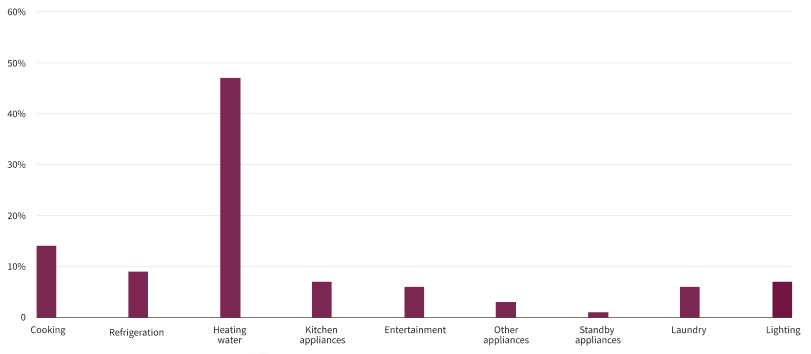
Your refrigerator consumes an average of 9% of your total home energy use.
- Avoid unnecessary visits to the refrigerator (we know it’s hard).
- Set your fridge to 4 °C and your freezer to -18 °C.
- Ensure that there is adequate space behind your refrigerator to allow heat to dissipate.
3. Don’t overfill the kettle
Only fill the kettle with and boil as much water as you need. Don’t fill it to the brim if you are only making one cup of tea.
4. Dry it out
The tumble dryer is an electricity vampire, so air-dry your clothes when you can.
5. Put a lid on it
If you’re cooking on the hob, a lid locks in the heat. It’s a super simple tip, but will save energy.
6. Clean the lint filter in your dryer regularly
As a dirty filter uses more energy, clean it regularly and don’t forget to clean the tubing too. Your vacuum cleaner’s long nozzle makes it easier to clean out particles that get beyond the filter.
7. Cook using the right size burner
Use your stove’s small burners for small pots, and large burners for large pots when cooking.
8. Use microwaves and toaster ovens to cook or warm leftovers
These use less energy than conventional ovens, resulting in less energy use when you cook.
Day-to-day habits
1. Let the sunlight in
Not only does natural light help improve your mood, but it also eliminates the need for a desk lamp. Make sure that you open your blinds and curtains fully every morning.
2. Keep an eye on the kids
Check that your children’s electrical devices aren’t left on and teach them to be energy-conscious. Minimise the number of electrical gadgets that are used at the same time. Everything does not need to be on at once.
3. Be eco-clever
Use the eco setting on your dishwasher to heat the water more efficiently at low temperatures. You can use the dry sensor feature on the dryer and remember to clean the lint trap between dry cycles.
4. Load it up
This is one of the easiest ways to conserve energy at home. Wait for a full load before running your dishwasher and washing machine. You don’t need to do laundry every day. It can be tempting to put small loads of washing into the machine, but waiting until you have a full load will be much more energy-efficient.
Don’t use electricity if you can find an alternative
1. Save money with solar energy
Solar energy is a safer alternative to electricity and gas. It is cheaper (actually, almost free) and much kinder to the environment. And best of all, it can save you from load shedding and give you free electricity for years to come.
2. Keep cool in summer and warm in winter without heaters or air-conditioners
Wear lighter clothes in summer and a few extra layers in winter instead of changing thermostat settings. Close your blinds or curtains to keep the sun out during summer and keep them open during winter to bring in the sunshine.
Take control of your energy
Knowledge is always power! The average South African household consumes more electricity on items that can be controlled, so start by looking at the energy consumption graph below to see where you may be consuming most of your electricity.
Household energy consumption
Absa
Disclaimer: This article is solely intended for information. It does not constitute financial, tax or investment advice or recommendation. Please speak to a financial advisor or registered financial professional before making any financial decision(s).