
News
Welcome Remarks: SADC Sustainable Finance Forum 2025
Publication Date: 09/06/2025
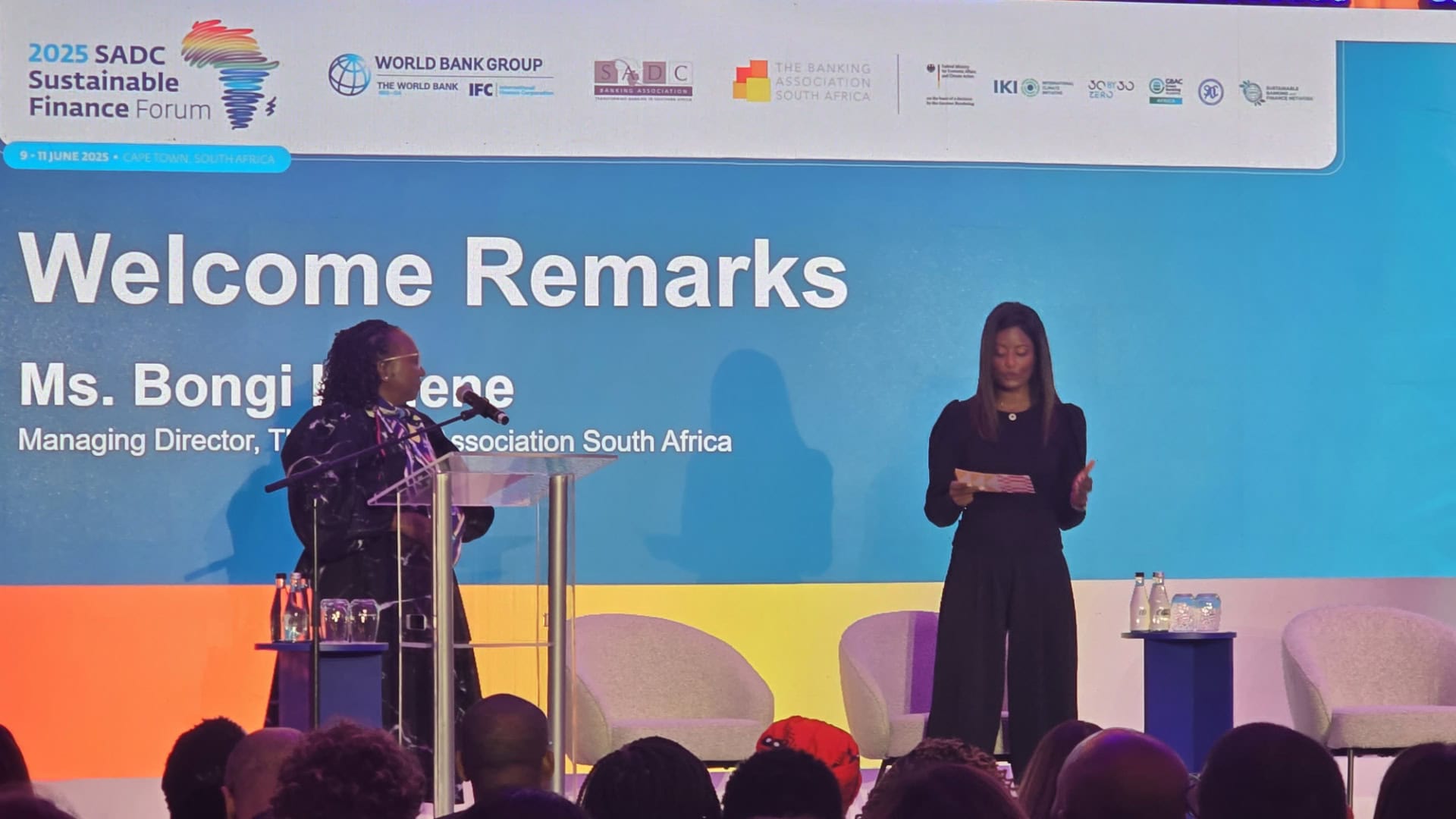
Distinguished guests,
It is a true pleasure to welcome you to the 2025 SADC Forum on Scaling Sustainable Finance. On behalf of BASA, the SADC Banking Association, and our partners the International Finance Corporation (IFC), I thank you for joining us here in Cape Town.
It is fitting that we meet in the City of Cape Town, where green literally meets blue.
Framed by her mountains, oceans, biodiversity and vibrant communities, Cape Town is a place where nature, people, and history meet. It is home to the unique fynbos, which is part of the Cape Floristic Region, which I’m told is the smallest in size but richest in diversity. It is also a city of immense cultural richness, a place where many histories converge, and where social resilience is visible in every corner, from Bo-Kaap to Khayelitsha.
Yet Cape Town also reflects a microcosm of the issues we face as a region. It is a city of great beauty and opportunity, but also one grappling with historical injustice, inequality, climate stress, and systemic challenges that are all too familiar across our region.
These contrasting themes: people, and nature alongside socio-economic challenges, highlights not only a threat but an opportunity. This framing should serve as a reminder throughout the event as to why we are here: To have honest, collaborative conversations about how finance, when used intentionally, can be a force that bridges divides, restores ecosystems, and builds lasting prosperity.
This Forum is about scale, not just in terms of capital, but in terms of ambition, impact, and collective effort. It is about moving from ideas to action, and mobilising systems that work for people and our planet.
And it is especially meaningful that we gather at this time. With South Africa chairing the G20 this year, we have an opportunity to shape the global sustainable finance agenda from a Southern Africa (global south) perspective, but it should not end here, we should use these platforms to firstly strength our work and then be a pioneer on the global stage.
Cape Town is but one example of our region, Southern Africa, is incredibly interconnected but also diverse. We are 16 countries strong, each with its own cultures, languages, and economies. We vary in size, in climate, and in economic makeup.
Yet despite these differences, we share a deep set of values. “Ubuntu” the understanding that “Umuntu Ngumuntu Ngabantu – I am because we are.” It is a concept that transcends our borders (each country has their own word but similar meaning). It teaches us that our individual wellbeing is linked to that of our communities, and to the natural world that sustains us.
Although sustainable finance is a universal concept, we should appreciate that African philosophy aligns to sustainable finance. It reminds us that our economies must serve people. That progress must include the vulnerable. That development must work in harmony with nature. And that we are stronger together.
As a region, we are deeply connected to our environment. Nature is not something separate from us, it is part of our identity. Whether it’s the forests of Zambia, the wetlands of Botswana, the coastlines of Mozambique, or the highlands of Lesotho, our livelihoods, food systems, cultures, and futures are tied to the resilience of our ecosystems. This has been our way!
SADC countries and key role players already taking important steps to respond to climate risks and promote inclusive, green growth (we will learn about some of these initiatives). But we know more is needed. This Forum is about building the partnerships, policies, and platforms to take us further, together.
Sustainable finance might be seen as a trend in other parts of the world and swings to shifting politics. But in Africa, it is necessity. We are on the frontlines of climate change, facing rising temperatures, water stress, biodiversity loss, youth unemployment, and energy poverty. Yet within these challenges lie powerful solutions. Our natural assets that I mentioned from the forests and wetlands to our fertile soils and African sun (solar). These are not just symbols of heritage, but green engines of resilience and growth. If protected and leveraged responsibly, they can support climate adaptation, generate sustainable livelihoods, and unlock new investment opportunities. Sustainable finance offers the means to turn vulnerability into strength by directing capital where it can do the best for both people and our planet.
We must acknowledge that finance cannot be neutral. It either accelerates resilience and inclusivity, or it reinforces the status quo. Our aim is to ensure it does the former.
The conversations we hold over the next three days will not shy away from the complexity. But they will also be grounded in pragmatism, partnership, and possibility.
The financial sector, especially banks and Development Finance Institutions (DFIs), holds immense potential to lead. Green, Social, and Sustainability bonds, blended finance, and sustainability loans are just some of the instruments we now have at our disposal. But tools are only useful if they are used.
That is why this is not only about high-level dialogue, but also about the how! How we scale sustainable finance in real terms. How we structure transactions that is transformative, that balances returns with impact. How we build pipelines of investable projects. How we strengthen regulatory frameworks and align taxonomies. And how we deepen regional cooperation across markets.
Over the next three days, this Forum will cover a wide range of topics critical to the future of sustainable finance in our region.
Today, we begin with high-level keynotes and panel sessions. These will explore the policy and innovation landscape, the role of capital markets, and real-world examples of sustainability-themed instruments making a difference across sectors, from renewable energy to marine conservation.
Tomorrow, we will dive deeper into practical case studies and panel discussions. We will highlight regional success stories. We will also explore the crucial role of local banks, stock exchanges, and public, private partnerships in moving capital to where it matters most.
Then, on Day Three, we shift to capacity building. These sessions will focus on the fundamentals, understanding green and blue instruments, managing climate-related financial risks, and designing national sustainable finance roadmaps. (Each participant will receive a certificate of completion from the IFC’s Green Banking Academy).
Throughout the Forum, you will also find networking opportunities, moments for reflection, and space to forge new partnerships. We encourage you to use this space to ask bold questions, share lessons honestly, and collaborate across sectors and borders AND to re-emphasis my plea last year for action-provoking discussions.
At this point, I want to acknowledge that at the South Africa event last year, there were clear calls to take these conversations beyond our borders. Today is a testament to that intention and I believe it signals the beginning of stronger regional collaboration and concrete action.
Before I close, I also want to emphasise this: sustainable finance is not the responsibility of one champion, one financial institution, or one country. It requires the public sector to provide enabling regulation and incentives. It requires financial institutions to innovate and lead. And it requires civil society, academia, and the private sector to stay engaged and accountable.
The stakes are too high for siloed thinking. What we are building is not just a niche product within the system, it is a shared future. And like any strong foundation, it must be built with intention, with values, and with people at its centre.
Let us also remember that sustainability is not about ticking boxes. It is about transformation. It is about making sure that the capital flowing through our systems reflects the future we want to create, a future that is colourful (green and blue are themes of the conference), inclusive, and just.
As we begin this Forum, I encourage you to dig in. Challenge assumptions. Ask the difficult questions. And look for the expected and unexpected synergies.
Let Cape Town be our reminder: that even in the midst of challenge, beauty, resilience, and innovation are always possible.
Let ubuntu guide us: that we are strongest when we walk this path together.
Thank you once again to the IFC, the SADC Banking Association Secretariat, our supporting partners, and importantly each of you for being part of this conference and start of the journey.
I wish you a productive, inspiring, and impactful Forum.
Thank you.
Bongiwe Kunene
Managing Director BASA